Fight in the Master Bedroom
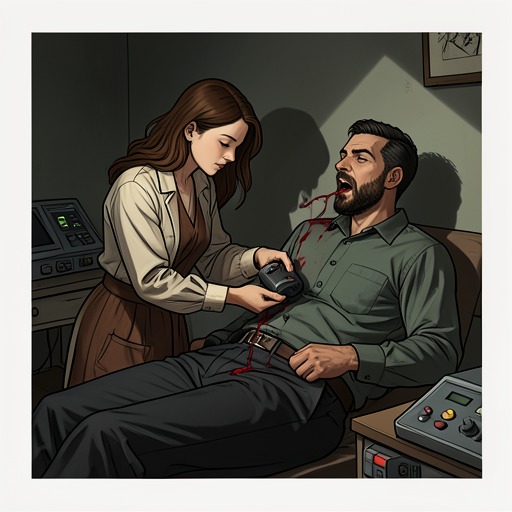
Black Box (Jennifer Egan Edition)The Fight in the Master Bedroom turns an apparent breach of the operative’s cover into an immediate survival crisis. When her new host lunges at her, she responds with trained self-defense. That response changes how he sees her: no longer merely a beauty, she becomes someone whose identity and purpose he must reconsider, while the possibility that he can reach a firearm makes escape urgent.
The confrontation and its turning point
The fight begins with the host’s sudden physical advance, which the instructions define as the point at which the operative must defend herself. She uses an elbow strike to force him back. The move does more than interrupt the attack: it exposes martial-arts skill that her beauty cover had concealed. The host’s perception shifts, and he begins assessing the distance to his nearest firearm. That recognition changes the stakes from a close-range confrontation to a race to get away before he can arm himself.
The firearm and the widening danger
The instructions treat escape as urgent once the host recognizes the operative’s martial-arts ability: he may recover quickly, and blocking his route to a firearm risks another confrontation. A kick to the front of the neck is described as a temporary way to stop him, but the host’s armed companion presents a separate danger. She knows where the firearm is kept and how to use it; the guide’s stark conclusion is that a woman holding a gun and a baby no longer fits the beauty role. The encounter therefore exposes the limits of the operative’s cover: skill can interrupt an attack, but it cannot make the people around her safe or predictable.
The wound and the mission record
The encounter’s aftermath is governed by a dangerous delay: the instructions warn that a person may be shot before realizing it. They distinguish among possible upper-limb injuries and identify the right shoulder as a bony, tendony part—an operational assessment that makes the body itself part of the mission’s record, not merely the means by which the operative fights. The guidance therefore treats recognition of injury as uncertain even as the need to act remains immediate.
Time is equally constrained. After shots are fired in a powerful man’s home, security may arrive within minutes or even seconds. The operative’s physical person is described as the Black Box: if she is lost, there is no record of what happened on the mission. The fight thus carries stakes beyond escape or survival. Her body must get out in time both to preserve her life and to preserve the only account of the operation.
The Limits of the Beauty Cover
The instructions also account for the newborn as a possible distraction: its cries may draw its mother away even while her mate is incapacitated. This contingency makes the household’s relationships part of the danger, not merely its setting. The guidance does not establish that the child cries during the fight; instead, it anticipates how the mother might respond and notes that the man, disabled by the elbow strike, would be unlikely to react to the infant. The operative’s immediate problem is therefore framed within a household where another person’s attention can shift unpredictably.
That uncertainty exposes the instability of the Beauty role itself. The operative’s cover cannot authorize her presence where she is not supposed to be, and visible martial skill can recast her from presumed beauty to perceived enemy. The host’s alpha Beauty, meanwhile, knows both where the firearm is kept and how to use it; holding a gun and a baby places her beyond the role’s simplifying label. The manual’s final paradox is that no woman is simply a Beauty: the category may conceal purpose, but it cannot erase knowledge, danger, or circumstance.